
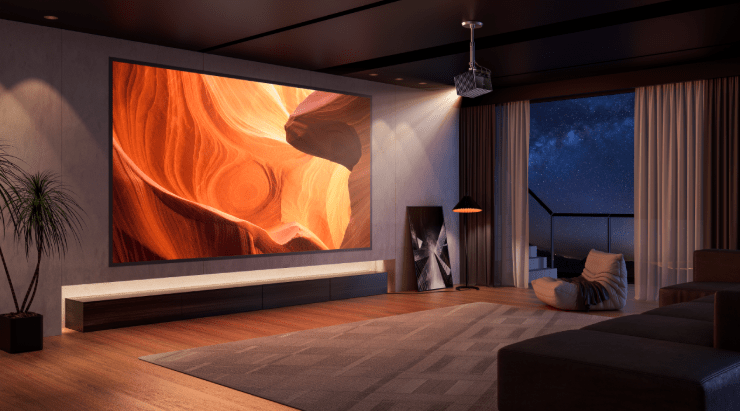
Minimalist interior design is all about clean lines, negative space, and intentionality. A massive 85-inch television is the exact opposite of that philosophy. When turned off, a television is a giant, inescapable black void that dictates the orientation of your entire living room furniture layout. If you want a truly cinematic viewing experience without ruining the aesthetic flow of your home, bouncing light onto a wall is the only logical solution.
The beauty of a projected image is that it vanishes the moment you press the power button. The screen rolls up, the light stops, and you get your living room back. But transitioning to this kind of setup brings its own set of interior design challenges. The hardware generating that image still has to live somewhere in the room.
If you invest in a premium 4K projector, you are dealing with a substantial piece of technology that requires power, data cables, and unobstructed airflow. Leaving it sitting on a coffee table means dealing with a permanent nest of tangled cords. Hard-mounting it overhead is the classic approach, but simply bolting a heavy metal bracket to your pristine white drywall isn’t exactly subtle. To achieve a truly invisible setup, you need to stop thinking like a tech enthusiast and start thinking architecturally.
Architectural Concealment Strategies
How do you suspend high-end AV equipment overhead without making your living room look like a sports bar? Custom installers use a few highly effective concealment methods that keep the room looking clean:
- Motorized Recessed Lifts: This is the gold standard for stealth integration. The unit sits completely hidden inside the ceiling cavity behind a flush-mounted piece of drywall. When you turn the system on, a quiet motorized scissor-lift lowers the hardware into the room. When the movie is over, it retracts and disappears completely.
- Custom Bulkheads and Soffits: If you cannot physically cut into your ceiling joists to install a lift, building a custom drywall bulkhead at the back of the room is a highly effective alternative. The hardware sits inside the hollow soffit, projecting through a precisely cut piece of aperture glass.
- The Faux Wooden Beam: For homes with rustic, farmhouse, or industrial aesthetics, hollowing out a decorative wooden ceiling beam allows you to stash the equipment entirely out of sight. This blends the technology directly into the existing architectural charm of the house.
The Logistics of the Installation
If you decide to utilize a dedicated Ceiling projector, the installation requires meticulous planning before anyone picks up a drywall saw.
The first major hurdle is data transmission. You cannot run a standard 15-foot copper HDMI cable through your ceiling and expect it to handle high-bandwidth video from your AV receiver or gaming console. Copper degrades over long distances, causing the image to drop out, flicker, or lose HDR metadata. You must run an Active Optical Cable (AOC). These cables use fiber optics to transmit heavy data over massive runs without any signal loss, ensuring the image remains pristine.
Secondly, you must address ventilation. High-performance light sources generate significant heat. If you enclose the hardware inside a tight soffit or a ceiling cavity, that heat has nowhere to go. The internal fans will spin at their maximum speed—creating a loud, distracting drone during quiet movie scenes—and the unit will eventually shut itself down to prevent overheating. Any hidden enclosure must feature silent, thermostatically controlled intake and exhaust fans to keep the ambient temperature stable.
The Importance of Lens Shift
Consider the structural layout of your ceiling. It is rarely possible to mount hardware in the exact geometric center of your seating area. You will almost always run into lighting fixtures, structural ceiling joists, or HVAC ducts right where you want to place the mount.
This is where optical lens shift becomes your safety net. A unit with a generous horizontal and vertical lens shift allows you to physically offset the installation point. You can mount the device slightly to the left, right, or higher up, and physically shift the glass lens to move the image back to dead center. This prevents you from having to use digital keystone correction, which compresses the image and destroys native resolution. Lens shift gives you the architectural flexibility to hide the hardware where it makes the most sense for the room’s design, not just where the math dictates it must go.
Taming the Ambient Light
Hiding the hardware is only half the battle. A minimalist living room usually features large windows, white walls, and plenty of natural light. If you shoot a high-resolution image onto a standard white wall in a bright room, the image will look terribly washed out. The light bounces off the white paint, hits the ceiling, and scatters back down, destroying your contrast.
To fix this without hanging heavy velvet blackout curtains, you must pair your hidden hardware with a motorized drop-down screen that retracts into the ceiling. More importantly, you must choose the right surface material.
| Screen Technology | Ideal Environment | Visual Impact in a Living Room |
| Matte White | Dedicated, pitch-black theater rooms. | Poor. Washes out easily if any ambient room light or white ceilings are present. |
| Acoustically Transparent | Rooms where the center speaker must be hidden behind the screen. | Good, but the micro-perforations often require a darker room to maintain contrast. |
| ALR (Ambient Light Rejecting) | Modern living rooms with windows, lamps, and white ceilings. | Excellent. Absorbs side/top light and reflects the image directly to the sofa. |
The ultimate goal of invisible technology is to ensure that your living space remains a living space, rather than a dedicated, single-use media cave. By carefully considering ventilation, utilizing fiber optic cabling, and selecting an ambient light-rejecting screen that rolls out of sight when not in use, you can achieve the impossible. You get to enjoy a massive, color-rich cinematic canvas at night, and a clean, architecturally pure living room during the day. The technology serves the room, rather than the room serving the technology.

Singh is an experienced spiritual writer and the resident author at Guruvanee.com. With a deep passion for exploring the mystical aspects of life, Singh delves into various spiritual traditions, philosophies, and practices to inspire readers on their spiritual journeys.